
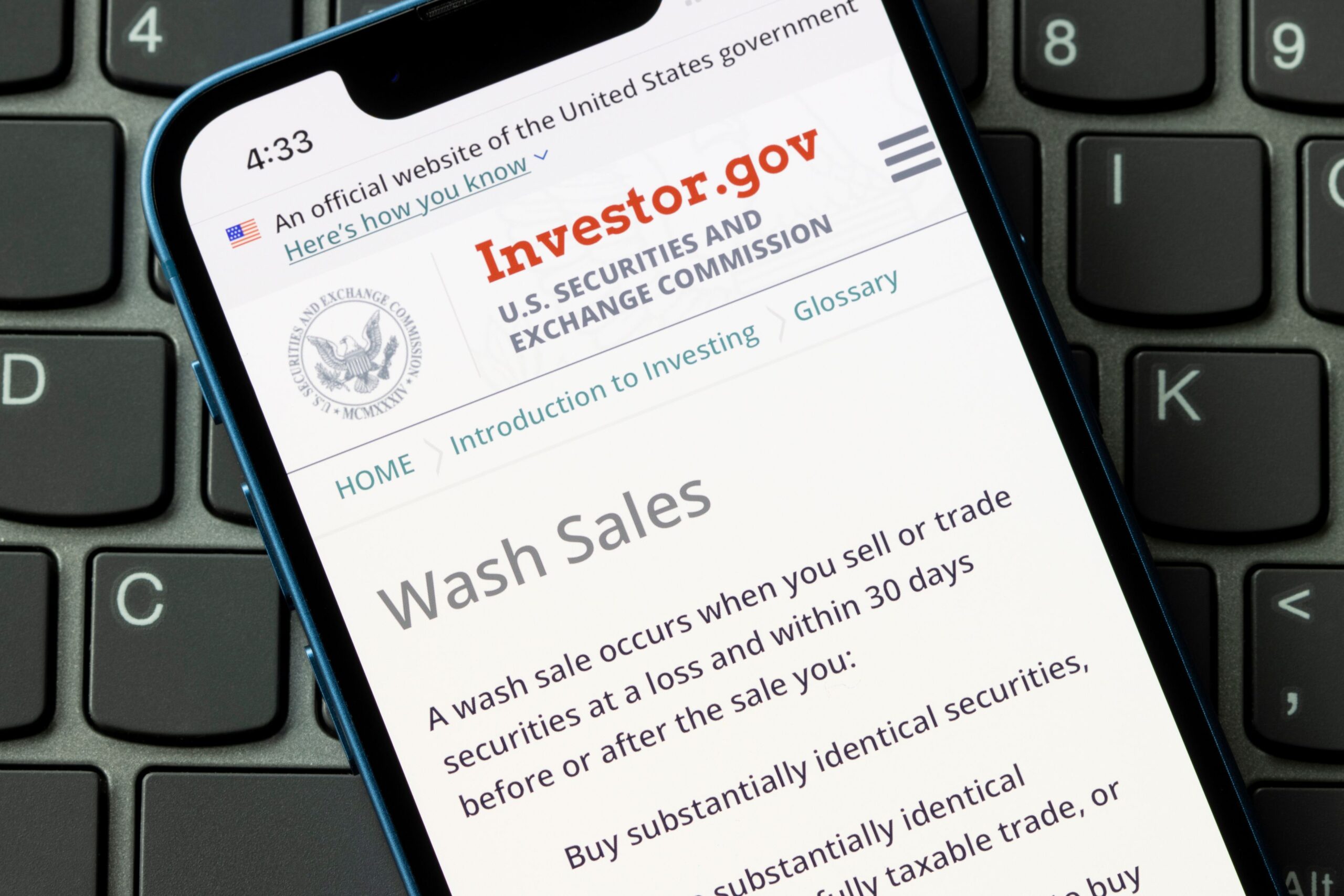
It’s an age-old dilemma—I love making money in the market but I hate paying taxes on the gains. What’s an investor to do? One answer is tax loss harvesting which allows you to sell losers in your portfolio and use the losses to offset capital gains. It’s effective. It works. But remember, when you’re talking about reducing the amount of taxes you pay, the IRS is involved and you need to know the rules, specifically the Wash Sale rule.
History
In the early 1900’s it was common for people to sell a security at a loss so they could write it off their taxes and then buy back the same security on the same day as the sale. In November 1920, a Wall Street Journal reader identified as R.H.T. wrote in with a question:
“I do not want to sell these stocks at the present market. Would it be legal for me to sell these stocks and deduct the loss from this year’s income, even though I bought them in again the same day?”
The Journal said the transaction was permitted under the law.
Federal lawmakers realized the government was losing tax money because of this practice of selling and buying back on the same day. A 1921 Senate conference report describes action taken by senators to stop “evasion through the medium of wash sales.” They passed a law that barred taking a tax deduction if, within either 30 days before or 30 days after a sale, an investor bought a security that was “substantially identical” to the one sold.
Example
Let’s assume you have a $10,000 capital gain from the sale of ABC stock. You have to pay the highest capital gains tax of 20%. So, your tax bill on the transaction is $2,000.
But let’s suppose you sold XYZ stock at a loss of $5,000. The net capital gain for tax purposes would be $10,000 (ABC) – $5,000 (XYZ) = $5,000. The tax bill is now 20% of $5,000 or $1,000 which you can deduct from your taxes.
However, if you repurchase XYZ stock, or a stock substantially identical to XYZ, 30 days before or 30 days after the sale, the above transaction is counted as a wash sale and the loss is not allowed to offset any gains.
What securities are covered by the Wash Sale Rule
Generally, if a security has a CUSIP number (a unique nine-character identifier for a security) then it’s most likely subject to wash sale rules. That means stocks, exchange-traded funds (ETF), and mutual funds. In addition, selling a security at a loss and then buying an option on that same security will also trigger the wash sale rule.
Avoiding a Wash Sale
One way to avoid a wash sale on an individual stock while still maintaining your exposure to the industry of the stock you sold at a loss, is substituting a mutual fund or an exchange-traded fund (ETF) that targets the same industry.
Unlike ETFs that focus on broad-market indexes, like the S&P 500, some ETFs focus on a particular industry, sector, or other narrow group of stocks. These ETFs are a way to regain exposure to the industry or sector of a stock you sold, but they generally hold enough securities to pass the test of not being substantially identical to any individual stock.
It’s a little trickier swapping an ETF for another ETF, or a mutual fund for a mutual fund, or even an ETF for a mutual fund because there are no clear guidelines about what constitutes a substantially identical security. The IRS makes that decision.
What is the Wash Sale penalty
If the IRS decides you violated the wash sale rules, there is not an official penalty or slap on the wrist. It just means you can’t use the loss on the sale to offset gains and you end up paying more taxes than you expected.
However, there is good news. Even though you can’t deduct the loss, it’s added to the cost basis of the new investment. The holding period of the investment you sold is also added to the holding period of the new investment. Both may be a benefit when you sell the new investment sometime in the future.
Getting a letter from the IRS telling you a loss has been disallowed is never a good thing. So, you may want to lean to the side of caution and wait until 30 days after you sold the original investment at a loss before buying anything new.
You can find more information about wash sales in IRS publication 550.
Disclaimer:
This information is presented for informational purposes only and does not constitute an offer to sell, or the solicitation of an offer to buy any investment products. None of the information herein constitutes an investment recommendation, investment advice or an investment outlook. The opinions and conclusions contained in this report are those of the individual expressing those opinions. This information is non-tailored, non-specific information presented without regard for individual investment preferences or risk parameters. Some investments are not suitable for all investors; all investments entail risk and there can be no assurance that any investment strategy will be successful. This information is based on sources believed to be reliable and Alhambra is not responsible for errors, inaccuracies, or omissions of information. For more information contact Alhambra Investments at 1-888-777-0970 or email us at info@alhambrapartners.com.


Stay In Touch